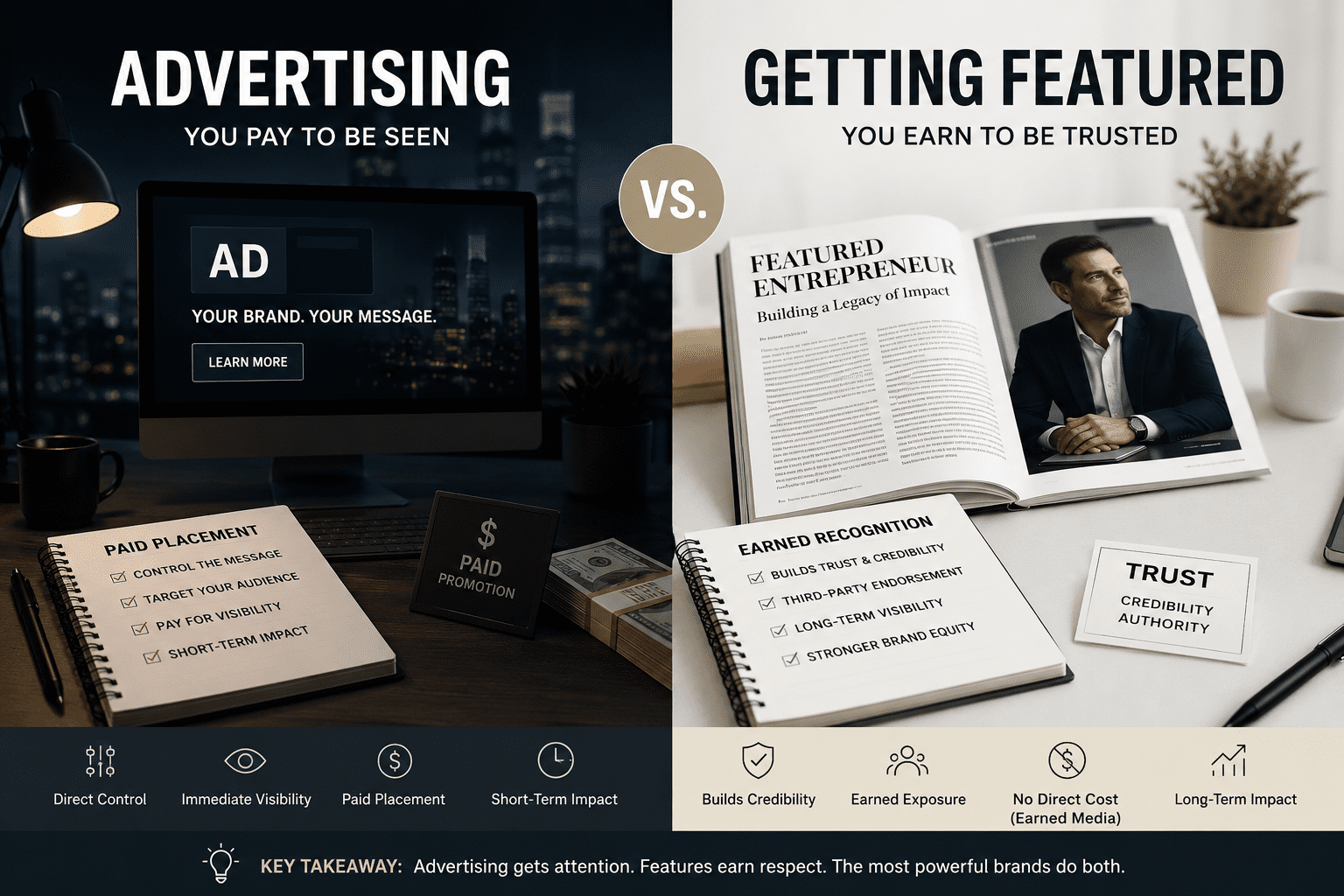
Both paths put your name inside one of the world’s most recognized luxury publications. That is where the similarity ends. Advertising in Vogue buys placement. Getting featured in Vogue earns it. The distinction is not semantic. It determines how retailers, investors, immigration officers, and high-value clients interpret what they see. This post breaks down exactly what separates a paid Vogue ad from a genuine Vogue editorial feature, and why that gap matters for personal brand authority, commercial outcomes, and visa documentation.
What Advertising in Vogue Actually Means
Advertising in Vogue means purchasing space within the publication to display your brand message. Vogue US, owned by Condé Nast, operates with clearly defined ad inventory across print, digital, and social. A full-page print ad in Vogue US runs at an open rate above $187,000. Cover positions push higher, with some formats exceeding $225,000. Digital advertising through Vogue’s owned properties operates on separate rate structures negotiated directly with Condé Nast’s commercial team.
The placement is controlled by you. You supply the creative. You approve the copy. You choose the format. Vogue’s editorial team has no involvement in the message, the imagery, or the narrative. The ad is clearly marked as advertising.
That transparency is also the ceiling on what advertising delivers. Readers recognize ads as paid content. The presence of a full-page Vogue ad confirms your marketing budget, not your editorial relevance.
What Vogue Advertising Is Suited For
Advertising in Vogue is a legitimate and effective channel for certain goals. Direct-response fashion campaigns, seasonal product launches, and broad luxury brand awareness campaigns have used Vogue ad placements with measurable ROI. Legacy fashion houses like Gucci, Louis Vuitton, and Chanel run consistent Vogue ad programs precisely because their brand recognition is already established, and they are reinforcing awareness rather than building credibility from scratch.
For a newer brand, an executive building a personal brand, or a founder seeking third-party validation, advertising in Vogue delivers reach without authority. The page is yours. The credibility of the editorial context is not.
What Getting Featured in Vogue Actually Means
An editorial feature in Vogue is content produced by Vogue’s editorial team or a credentialed journalist who decides, independently, that your brand, story, product, or expertise is worth publishing. No money changes hands for the placement itself. The feature exists because an editor made a journalistic judgment.
Vogue has been published since 1892 and now operates across 26 international editions. The editorial standards across those editions reflect institutional authority built over more than a century. A Vogue editorial feature carries institutional credibility that paid advertising cannot replicate.
That independent editorial judgment is exactly what makes a Vogue feature carry weight in ways that advertising cannot. A 2026 study surveying 1,622 respondents across four countries found that consumers trust a company 3.2 times more after seeing an editorial feature compared to a paid advertisement in the same publication. The format of coverage mattered more than the publication itself. Editorial features in Vogue generated that trust premium precisely because readers understand that editorial placement is earned, not purchased.
What Vogue Features Are Suited For
Editorial features in Vogue serve goals that advertising cannot reach. For founders and executives building personal authority, a Vogue feature is third-party validation from the most selective editorial institution in the luxury and lifestyle space. For brands entering premium retail or seeking partnerships with luxury wholesalers, a Vogue editorial mention signals that the publication’s editors consider the brand credible enough to recommend.
For visa applicants pursuing O-1 or EB-1A classifications, immigration officers prioritize third-party editorial coverage in authoritative publications that demonstrates independent recognition and extraordinary ability. Editorial features provide that; paid advertisements do not. The distinction is not interpreted loosely. An immigration attorney submitting a Vogue ad tear sheet as evidence of media coverage would face immediate challenges from USCIS reviewers.
The Core Difference: Who Controls the Narrative
The most precise way to understand the gap between advertising in Vogue and earning a Vogue feature is this: advertising puts you in control of the message; editorial gives control to Vogue, and that transfer of control is precisely what creates authority.
When you pay for a Vogue ad, every reader understands you wrote it. When Vogue’s editorial team writes about you, every reader understands that Vogue decided to write about you. Those two conditions generate entirely different responses in how people evaluate your brand.
This distinction has downstream effects across every high-stakes context you operate in.
Investor due diligence: investors reviewing a founder profile weigh independent press mentions differently from paid placements. A Vogue editorial feature signals that credible media has independently assessed and endorsed the brand.
Retail buyer conversations: premium retailers evaluating a new brand supplier look for editorial endorsement as a signal that the product has been vetted by the market. An advertising placement does not carry that signal.
Visa petitions: immigration officers are trained to identify self-promotional materials. Earned editorial coverage carries full evidentiary weight; sponsored content, press releases, and self-published material do not qualify. A Vogue editorial feature is independent recognition, which is what USCIS evidentiary standards require.
Can You Turn Advertising in Vogue Into Editorial Coverage?
Advertising spend does not translate into editorial access. Vogue’s editorial and commercial departments operate with separation, which is a structural protection for the publication’s credibility. A brand running a significant advertising campaign in Vogue is not on a shortcut to editorial features. Editors make coverage decisions on newsworthiness, brand relevance, and editorial fit, independent of commercial relationships.
Some brands attempt to leverage advertising spend as a conversation opener with the Vogue commercial team, hoping that relationship bridges to editorial. It occasionally results in native advertising partnerships or brand integrations, but these are clearly labeled as sponsored content and do not carry the same credibility weight as genuine editorial.
If the goal is genuine editorial coverage in Vogue, the path runs through PR strategy, not media buying.
How Editorial Features in Vogue Are Secured
Editorial coverage in Vogue comes through one of two routes: organic pitch outreach to editors, or PR agency placement work with documented editorial relationships and outcomes.
The organic route requires a brand or individual with established editorial newsworthiness: a compelling story angle, a product or expertise that fits Vogue’s current editorial calendar, and access to the right editor. Cold pitches to Vogue receive a low acceptance rate. The publication receives a high volume of submissions and maintains strict editorial selectivity.
The PR agency route, when working with a firm that has genuine editorial relationships and a track record of Vogue placements, is more reliable for founders and executives who need coverage within a defined timeframe. The critical distinction is working with an agency that secures real editorial features, not sponsored content or native advertising formatted to look editorial.
S99 PR secures editorial placements in Vogue and other tier-one outlets for founders, executives, and personal brand builders who need verified media coverage. The placements are editorial, indexed permanently, and carry the full authority of the Vogue brand. If you want to understand what a Vogue feature placement looks like for your specific goals, the S99 PR Vogue placement service is the starting point.
The SEO and AI Visibility Gap
Advertising in Vogue generates no indexed content about your brand on vogue.com. Display ads are not crawled by search engines as editorial endorsement. They do not surface in Google results when someone searches your name. They are not cited by AI platforms.
An editorial Vogue feature, by contrast, creates a permanently indexed page on vogue.com with your name, brand, and story. That URL is cited by ChatGPT, Perplexity, Google AI Overviews, and other AI-powered platforms when users ask about your industry. The domain authority of vogue.com means a single editorial feature delivers compounding visibility that a paid ad placement never generates.
For founders building a personal brand with long-term search presence in mind, this SEO and AI citation gap makes the choice clear. Advertising in Vogue disappears when the campaign ends. An editorial feature stays live, indexed, and discoverable indefinitely.
When Advertising in Vogue Makes Sense
There are legitimate scenarios where advertising in Vogue is the right investment. If you have an established brand with strong editorial presence already, ad placements reinforce awareness at scale. Seasonal campaigns, new collection launches, and event promotions tied to specific Vogue issues are all sound applications of Vogue advertising spend.
The mistake is using advertising as a substitute for editorial coverage and expecting the same credibility outcomes. These are different tools with different outputs. Understanding that distinction is the first step in building a media strategy that actually delivers authority.
Getting the Vogue Feature You Need
If your goal is credibility, visa evidence, investor validation, or long-term personal brand authority, advertising in Vogue is the wrong tool. The outcome you are looking for comes from a Vogue editorial feature, and that requires either a well-placed PR campaign or direct editorial outreach with a story angle the editors want to publish.
S99 PR works with founders, executives, and visa applicants to secure earned editorial placements in Vogue and other tier-one publications with guaranteed outcomes. If you have a timeline, a visa petition in progress, or a brand positioning goal that requires Vogue-level credibility, the S99 PR Vogue feature service is built for exactly that. Book a strategy call to confirm whether your brand is the right fit and what a placement timeline looks like. Every engagement at S99 PR begins with a clear scope and a guaranteed result, not a retainer and a hope. Learn more at s99pr.com/get-featured-in-vogue/.
Frequently Asked Questions
- What is the difference between advertising in Vogue and getting featured in Vogue?
Advertising in Vogue means purchasing ad space. The placement is paid, the content is controlled by the advertiser, and it is clearly labeled as advertising. Getting featured in Vogue means Vogue’s editorial team independently decided to publish content about a brand or individual. Editorial features carry institutional credibility that paid advertising cannot replicate because they represent independent journalistic judgment rather than a commercial transaction. - Does advertising in Vogue count as media coverage for an O-1 or EB-1A visa?
No. Paid advertising in Vogue does not satisfy USCIS evidentiary requirements for O-1 or EB-1A visa applications. USCIS requires published materials in major media under 8 CFR Section 204.5(h)(3)(iii), which means independent editorial coverage. A paid ad is self-promotional material and does not qualify as independent recognition. Only earned editorial features in qualifying publications meet the evidentiary standard. - How much does advertising in Vogue cost?
A full-page print ad in Vogue US has an open rate above $187,000. Cover positions exceed $225,000. Digital advertising through Vogue’s owned platforms is negotiated separately with Condé Nast’s commercial team. These figures are for reach-based advertising only and do not produce editorial credibility or indexed content on vogue.com. - Can spending on Vogue advertising help secure an editorial feature?
No. Vogue’s editorial and commercial departments operate independently. Advertising spend does not create editorial access or improve the likelihood of an editorial placement. Editorial features are secured through PR strategy, pitch work, and editorial relationships, separate from any advertising activity. - Is a Vogue editorial feature permanently available online?
Yes. Editorial features on vogue.com are permanently indexed by search engines and remain live after publication. The article continues to generate search visibility and AI citations indefinitely. This is fundamentally different from a Vogue advertising placement, which generates no indexed content about the featured brand and disappears when the campaign ends. - What type of Vogue coverage is worth pursuing for personal branding?
For founders, executives, and personal brand builders, the only Vogue coverage that builds durable authority is an editorial feature. It is independently authored, editorially controlled, and permanently indexed. It signals to investors, clients, retail partners, and immigration officers that Vogue’s editors chose to cover the individual or brand, a form of third-party validation that advertising cannot produce.